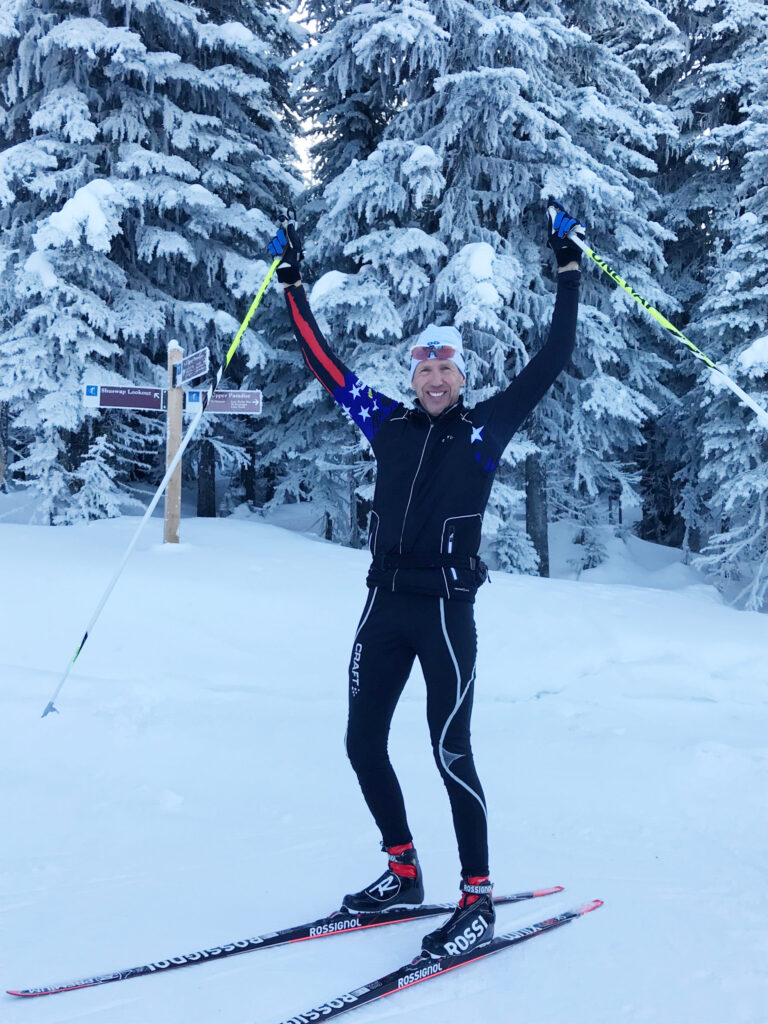
GLIDE SMARTER THIS SEASON
If you’re an ultra-competitive Nordic ski racer, have a fleet of skis, and know your heart rate in zones 1-5, then this article is probably not for you. However, if you simply love to ski and are looking to more easily keep up with friends or simply move up a wave in the Birkie, these straightforward tips may help.
If you’ve never tried skate skiing, check out our brand new Rental fleet of Salomon Skate Skis. You can also set up a lesson ahead of time and practice these tips with a qualified instructor.
Drawing from 41 years of skiing, training and competing, I’ve learned valuable lessons through practice and experience. Here are my seven essential tips for a more enjoyable ski experience—focus on one at a time, as each builds the foundation for the next.
SLOW DOWN TO SKI FASTER:
Impossible, you say? Well, it is quite possible as skiing slower allows you to focus on technique and enjoy the skiing. Improving your technique in turn will improve your efficiency and make you faster. So relax, slow down, and focus on the mechanics.
ACTION– Spend the majority of your ski time skiing at a pace easy enough to hold a conversation or sing your favorite tune. This will allow you to lower your heart rate and reduce fatigue so that you can focus on technique, rather than simply trying to ski fast. Reserve fast interval training for occasional sessions, not the majority of your skiing.
PROPER SHIN/ANKLE ANGLE:
In my opinion, one change that will improve your skiing the most is utilizing a forward ankle or shin angle. By simply pressing your knee forward and closing the angle of your ankle, you will dramatically improve your balance, power and efficiency. It will also shift your hips into an up and forward position, which is ideal for skate skiing.
ACTION– Begin with your ankle flexed forward and your knee slightly bent, aligning your knee directly over your toes. Pulse up and down in that position stacking the rest of your body, while maintaining good posture. Now shift side to side while you balance on one leg at a time. While doing these exercises, it is important to put your weight on the ball of your foot, not your heel! Apply this forward ankle angle on your skis for better glide, power, and stability.
HOLD A BENT ARM POSITION:
Trying to push yourself forward or up a hill by straightening your arms is exhausting. Instead, start poling with your hands at eye level with locked bent arms to engage your core efficiently. On flat terrain reach slightly forward; on hills pull your hands closer to your face.
ACTION– Find a gradual uphill trail and double pole up it with a locked bent arm position. You’ll be amazed at how powerfully you will ski when you lock your arms and use larger muscles.
HIPS UP, FORWARD and SQUARE TO THE TRAIL:
Many skiers often leave their hips back, which stalls their momentum. Instead, try to imagine that your hands are connected to your hips by an invisible cord and when swinging your arms up, your hips are pulled up and forward as well. In addition, keep your hips square and avoid twisting.
ACTION– On your living room carpet, do a standing long jump, flexing your knees and dynamically swinging your arms up and forward. For the purpose of this exercise, a 12” forward jump is sufficient. Connect your arm swing and hips to generate power, then apply this movement to your skiing. Focus on keeping your hips, knees and toes in the direction of the gliding ski.
“STACKED” BODY POSITION EQUALS BALANCE AND GLIDE:
Many beginner and intermediate skiers rush their movements in an attempt to ski faster, keeping their weight between both skis rather than committing to one ski. This causes unnecessary muscle fatigue without achieving proper glide. Instead, focus all your body weight on one ski at a time with your ankles flexed forward, knees bent, and hips forward.
ACTION– Stand on dry ground, balance on one leg with your ankle forward and your knee bent. Now hop sideways onto your other leg landing in the same position, holding it for 5 seconds. Feel the incredible stability of this position and try to duplicate it when you ski. It will improve your glide!
ENSURE YOUR MAXIMUM POWER IS DIRECTLY UNDER YOU:
Many skiers waste energy by only pushing their leg at the end of their skating stroke, essentially falling inward side to side. Instead, maintain a balanced position and apply power straight down into the snow during both skate push and double pole. On steeper inclines, some backward motion is okay, but always start your push directly under your body finishing to the side.
ACTION– From a balanced gliding position as described above, pause for a second, rise up, drop body weight onto your poles and skating leg, then transition to your other ski.
MANAGE YOUR PACE:
If you still get quite winded on the hills and find yourself wanting to catch your breath at the top, try conserving your energy on the ascent and push harder as you power over it. This strategy helps you skate or double pole more efficiently into the downhill and reach the next hill with greater momentum. Over a long race, this approach can make a notable difference.
I’m confident that these seven tips will help you ski more efficiently and enjoyably. It is important to recognize that altering movement patterns ingrained through long-term muscle memory takes sustained commitment and focus. If words on a page do not resonate, find an experienced coach who can offer constructive feedback. Better yet, come to ABR Trails and ask for me as I ski there most days in the winter and I’m always happy to help! Happy Trails.
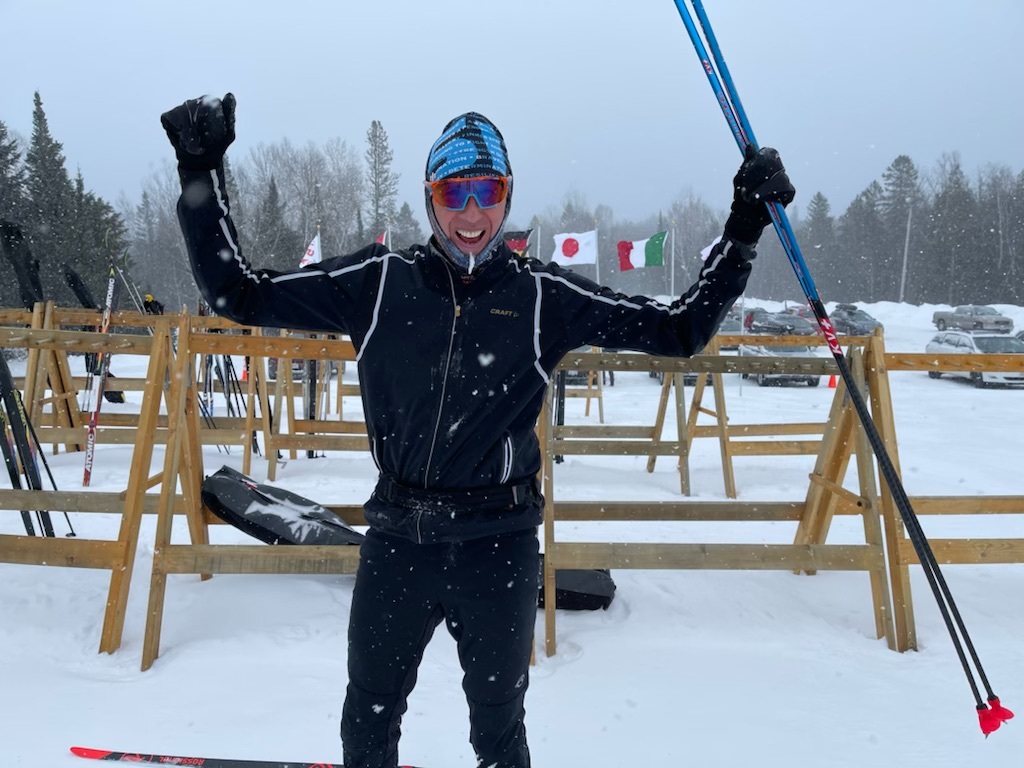
Greg Greene
Greg has spent more than 20 years in the elite wave at the Birkie, with a highest placement of 50th. Greg finished first in his age group at ages 50, 60, 65, and has a goal to do so again at age 70 this coming year. He has also competed in the Swedish Vasaloppet and has achieved several top 15 finishes in marathon races across the Midwest throughout his career. Greg’s love of skiing is infectious, and he is a true ambassador of the sport. Greg is currently serving on the Board of Directors for the Anderson Bluffs and River Trails (ABR) Foundation in Ironwood, Michigan.
Additional Articles THAT MAY INTEREST YOU

DISCOVER HOW TO ENHANCE HAPPINESS & HUMAN FLOURISHING
“Happiness” is often equated with comfort and ease. Research reveals that manageable challenges and mild stressors are crucial for fostering well-being and resilience. Read on to discover how to find your edge.

The Elusive Pursuit of Happiness
Definitions of happiness vary widely. There is no simple measure of happiness, but we undoubtedly recognize it when it is present. In this article you’ll discover practical strategies to cultivate a more joyful and meaningful life.